
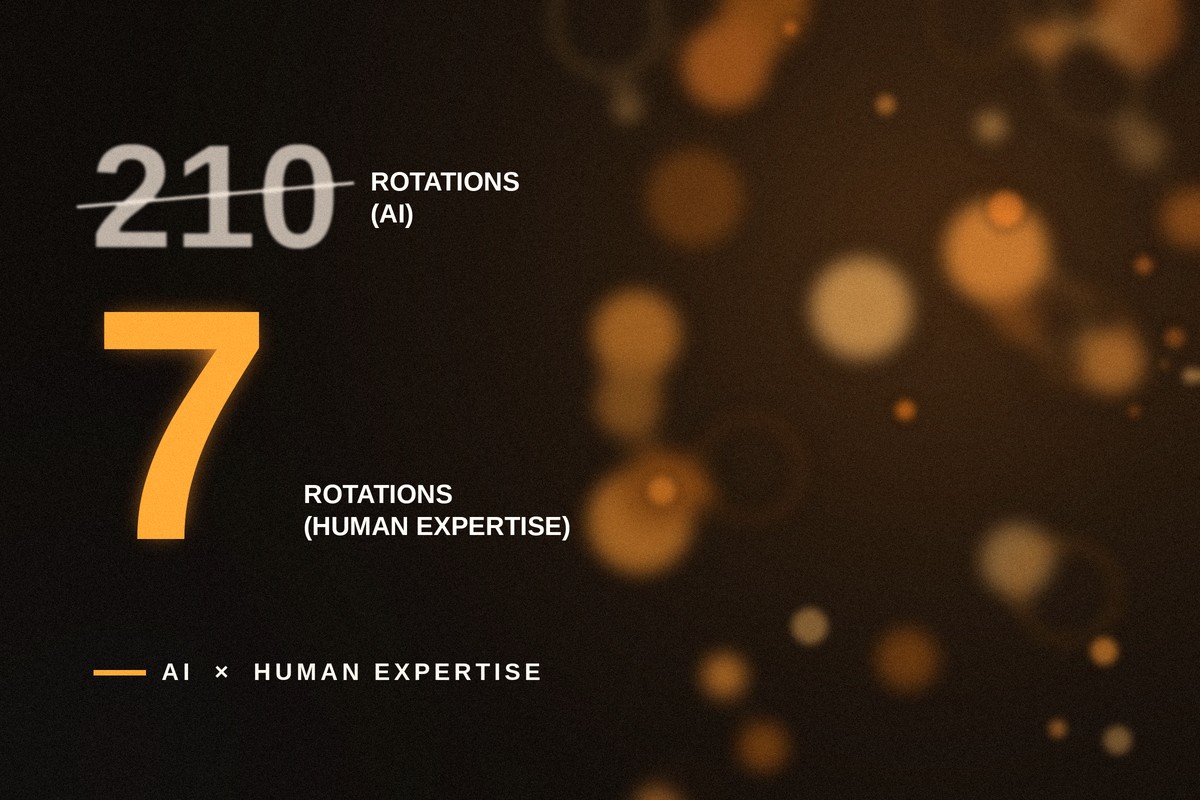
The AI proposed 210 rotations. A researcher solved it with 7.
What we learned when we put artificial intelligence and human expertise head to head on a real study.
A few days ago, at Adhara Research, we were designing a CLT (Central Location Test) for a client in the QSR sector. The challenge was simple to state: test 7 sauces with 350 consumers, each tasting 3. We needed a rotation plan that guaranteed statistical balance — every sauce evaluated the same number of times, in the same positions, with every possible pair represented.
We asked the AI we regularly work with to design the rotations. Within seconds, it returned a mathematically flawless plan: 210 distinct rotations (all 35 possible triads × 6 order permutations). Perfect balance. Exhaustive combinatorics. Technically beyond reproach.
The problem is that nobody who has ever run a real product test would propose 210 rotations.
The expert’s solution
When we consulted an experienced researcher on our team, he came back with a table of 7 rotations. Just 7. A cyclic design (known as a BIBD — Balanced Incomplete Block Design) where every sauce appears exactly 3 times, once in each position, and every pair of sauces coincides in exactly one rotation. Statistically just as balanced as the 210-version plan. Operationally, a different planet.
With 7 rotations, questionnaire programming is trivial. Fieldwork control is simple. If an incident arises, you know exactly where to look. And most importantly: when you have two people serving 7 different sauces to 10 participants at the same time, simplicity is not a luxury — it is a precondition for reliable data.
What the AI failed to prioritise
The AI had access to the same theoretical knowledge. Cyclic designs appear in any experimental design handbook. But it lacked something no language model can learn from reading: the prioritisation judgement that comes with experience.
An experienced researcher knows that a statistically perfect design that is unmanageable in the field is a bad design. They know that 95% of the statistical value is achieved with 20% of the complexity. And they know that “good enough” is almost always better than “perfect”, because perfect breaks the moment it meets reality.
That is not learned by processing text. It is learned by setting up product tests at 8 a.m. on a Tuesday, by seeing how an overly complex design breeds errors in the field, by feeling the pressure of a client expecting reliable results on a tight budget and a demanding timeline.
So what is AI actually good for?
It would be a mistake to conclude that AI adds no value. Quite the opposite. On the very same project, AI helped us to:
- Process the client’s briefing and return a first draft of the methodological proposal in minutes.
- Generate the 350 participant assignments across the 7 rotations, verify the balance and produce the file ready for programming — in seconds.
- Code open-ended questions (likes/dislikes) automatically, containing costs without losing qualitative richness.
- Collaborate on drafting and laying out the proposal in multiple formats, adapting to the client’s visual identity.
In other words: AI is extraordinarily useful for everything that is execution, processing and production. Where it falls short — at least today — is the expert judgement born of accumulated experience.
The winning combination
The conclusion is not “AI vs. humans”. It is that researchers who know how to integrate AI into their workflow will be unbeatable. Not because AI replaces them, but because it frees up their time for what really matters: thinking, interpreting and recommending.
Profiles limited to mechanical execution — tabulating data, filling in templates, producing generic reports — do have a problem. AI already does that, and does it faster.
But good researchers — those who read between the lines of what a client really needs, who design a questionnaire thinking about the person answering it with a piece of chicken in their hand, who spot the gesture in a focus group that contradicts what the participant is saying — they are going to be more productive and more valuable than ever.
At Adhara Research our team has spent more than 25 years bringing experience, judgement and intuition to our clients. Now, on top of that, we work with the best AI tools to multiply our execution capacity. The combination of both is what allows us to deliver more value in less time.
Because in the end, 210 rotations may be mathematically perfect. But 7 are the ones that work.
Want to know how we integrate artificial intelligence into our market research studies? Get in touch through our contact form: https://www.adhararesearch.com/en/contact/
